
Private Heritage Walking Tour in Paphos Old Town


This private heritage walking tour reveals Paphos through ancient civilization and cultural legacy. You will explore a UNESCO Heritage destination shaped by Greek, Roman, and Medieval influence. Historic streets and archaeological landmarks reflect centuries of transformation and architectural brilliance. How did Paphos become one of the Mediterranean’s most important cultural centers?
Ancient pathways and coastal landmarks reveal stories older than the United States. You will feel surrounded by Classical heritage and timeless cultural depth. Architectural treasures showcase the influence of mythology, empire, and civilization. Each step uncovers the evolution of Paphos through powerful historical eras.
A professional guide shares inspiring stories with knowledge and cultural refinement. The route offers a premium journey through archaeology, heritage, and Mediterranean history. Discover Paphos through ancient traditions and enduring architectural beauty.
Please note: The program and attractions may vary based on booking date/time and crowd conditions, ensuring each visit is a unique experience.

-
1
Paphos Castle
Paphos castle is a medieval fort and it is located at the west end of the harbor of the town was built by the Byzantine empire to protect it and was rebuilt in the 13 century by Lusigans but then destroyed by the Venetians. In 1592 the Ottoman Empire restored the western castle tower with some Venetian additions. In the castle, you will see that part of the castle has an enclosed courtyard in the middle, the ground floor of a central hall with small rooms on its two long sides, and used as a prison cell By the Ottoman Empire. The Ottomans handed over the administration of the island to the British in 1878, who used the castle as a salt store until 1935. when it was declared an Ancient Monument under The Antiquities law.
-
2
En Plo Gallery
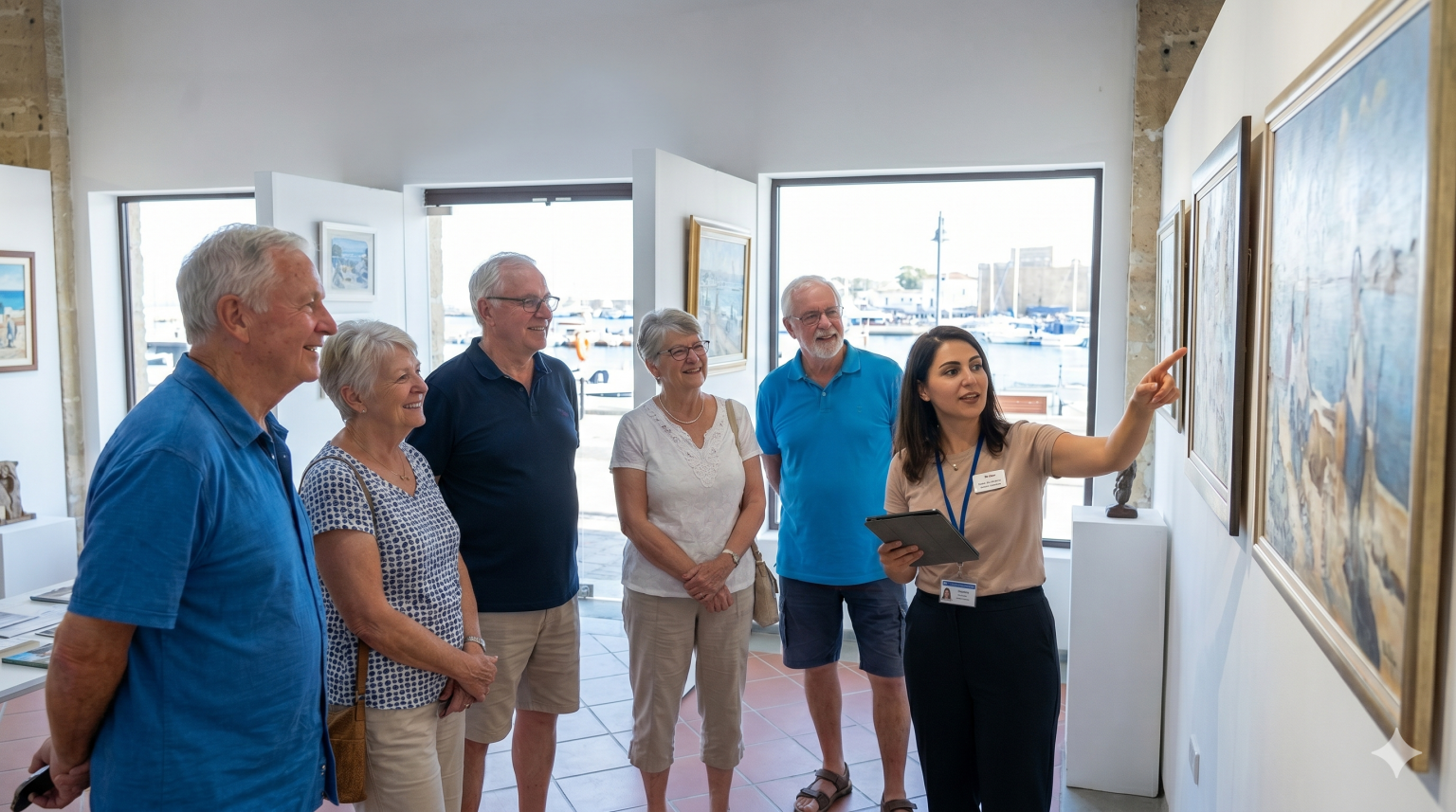
An old port building provides the venue for art exhibitions of various artists, such as painters, photographers, and craftsmen. Lectures and talks are also open to the general public.
-
3
Agia Kyriaki Chrysopolitissa
The church of Ayia Kyriaki Chrysopolitissa was built around 1540 as a Latin Church. On the site of a small church, it was destroyed in 365 by an earthquake. It is a stone-built church that received many additions and improvements over the centuries. On the church site, you will see Saint Paul's pillar, the remains of Chrysopolitissa Basilica, and the remains of the Roman Catholic Church.
-
4
Ottoman Baths
The Ottoman baths are from medieval times. It is a stone-built building with a stone vault of the Ottoman era and consists of three main rooms: a reception area, a second room where visitors used to undress, and the main bath.